
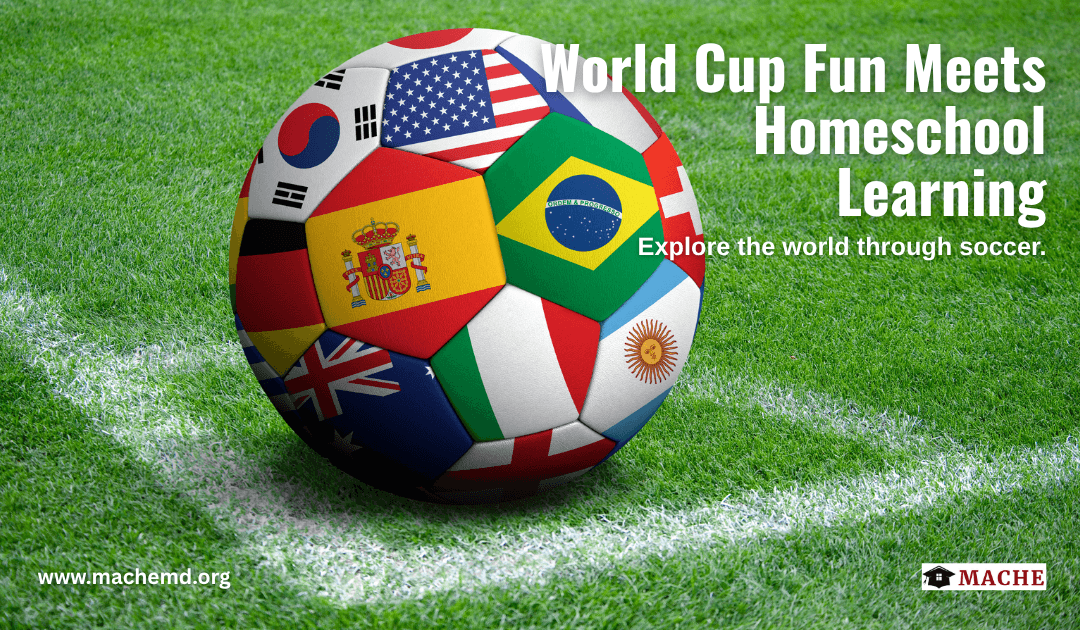
From the Pitch to the Classroom: Turn the World Cup Into a Homeschool Adventure
The cheers, the flags, the dramatic goals, and the excitement of countries from around the world coming together make the World Cup hard to ignore. For homeschool families, the tournament can also become a ready made learning experience that stretches far beyond the soccer field.
The 2026 World Cup is especially unique. It is the first men’s World Cup to feature 48 teams and the first to be hosted across three countries: Canada, Mexico, and the United States. With so many nations, cities, languages, and cultures connected to one event, families have countless ways to turn the excitement into meaningful learning.
Pick a Team and Explore the World
Invite each child to choose one country to follow. Start by locating it on a map, identifying its capital, studying its flag, and learning a few facts about its geography.
Then go a little deeper. What languages are spoken there? What foods are popular? What is the climate like? What landmarks might a visitor see?
Begin with the official list of World Cup teams, then use a kid friendly countries of the world guide to explore beyond the field. Children can create a simple “World Cup Passport” with one page for each country your family studies.
Younger children might color flags or place stickers on a world map. Older students can compare population, government, climate, or major industries between two competing countries.
Let the Scoreboard Teach Math
Soccer naturally creates opportunities for practical math.
Children can track goals, wins, losses, and score differences using the official World Cup fixtures and results. Younger learners can practice addition, subtraction, tally marks, and simple graphs. Older students can calculate averages, percentages, or compare team statistics.
Try creating a family prediction chart before a match. Everyone chooses a predicted winner and final score. Afterward, compare the predictions with the result and calculate who came closest.
For an extra challenge, ask students to design their own tournament bracket and explain the reasoning behind their choices.
Explore the Science Behind the Game
Why does a soccer ball curve through the air? How does the angle of a kick affect direction? What roles do force, friction, motion, and momentum play?
Take the lesson outside and experiment. Kick a ball using different parts of the foot. Try the same kick from different angles. Compare how the ball moves across grass, pavement, or another safe surface.
Older students can explore the physics of a curved soccer ball and connect what they observe to ideas about spin, airflow, force, and motion. Then ask them to make a prediction: what might happen if the ball spins faster or travels at a different speed?
Bring Culture to the Table
Choose a participating country and prepare a simple food or snack inspired by its culture. Listen to music, explore traditional art, or use language learning games to practice a few greetings, numbers, or everyday words.
Families can also compare how different countries experience soccer. Is it called soccer or football? How popular is the sport? Are there famous clubs, traditions, or celebrations connected to the game?
This is a great opportunity to remind children that learning about another culture means looking beyond stereotypes and approaching people with curiosity and respect.
Make the Final Whistle the Beginning
The World Cup may end, but the learning does not have to. A favorite team could inspire a geography study. A surprising statistic could lead to a math project. A powerful kick could spark a science experiment. A flag in the stands could introduce an entirely new culture.
Sometimes the most memorable homeschool lessons begin with something children are already excited to watch.
Want More Inspiration?
For more homeschool encouragement, practical resources, upcoming events, and helpful information for every stage of your homeschooling journey, explore the MACHE Blog and MACHE website.